Why remote owners need a routine, not more reports
An owner who lives in another city, runs two hotels, or simply has a life outside the business usually gets the news one of two ways: a phone call from the manager, or a pile of reports at the end of the month. The call tells you what the manager thinks matters. The month-end pile tells you what went wrong weeks too late to ask anyone about it.
A short routine every morning sits between the two. It takes about ten minutes over breakfast, it covers the places where money most often goes missing, and it is the same every day, so anything unusual stands out. Staff learn quickly that the owner reads the close each morning, and records get fuller as a result.
The routine below works whatever software you use. It assumes only that the hotel closes each day properly and that you can see the result from your phone.
What has to happen at the hotel overnight
You can’t read a day that hasn’t been closed. Before the routine is worth anything, two things must happen at the hotel every night, done by a named person at a set time.
- The Night audit closes the day. Today’s arrivals and departures are sorted, each guest still in the hotel has tonight’s room charge on their folio, and the hotel date moves on. Our Night audit guide has the full checklist for your night staff.
- Every cash shift is counted. The person who worked each drawer counts it at the end of their shift and records whether it is short, over or matches. If drawers are counted the next morning, nobody can say whose shortfall it is. The cash handover checklist covers this step by step.
If either is skipped, the morning read is built on an unfinished day, and the first thing to fix is the close itself, not anything you find in it.
The ten-minute morning routine
Check that yesterday closed (1 minute)
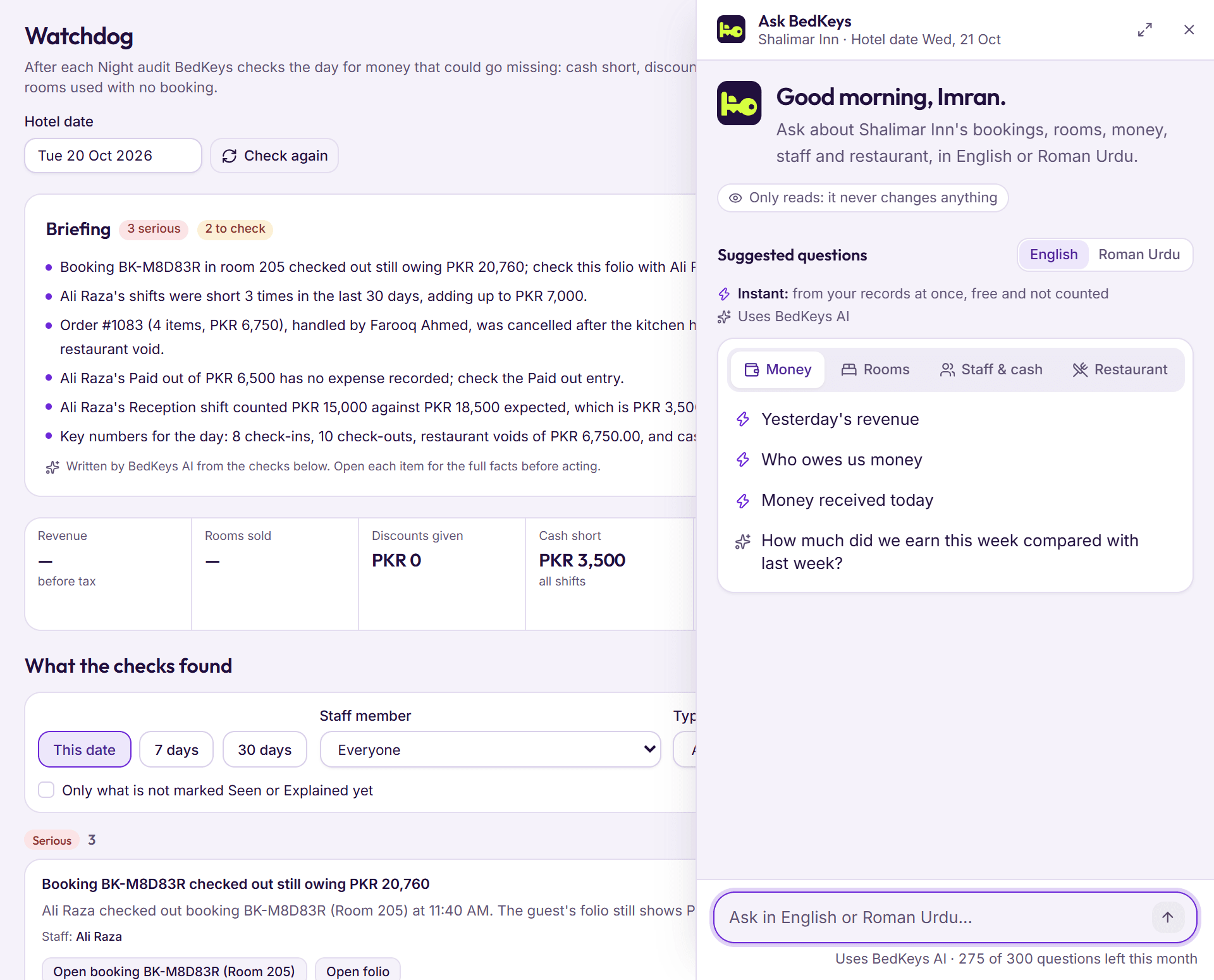
Look at the hotel date. If it still shows yesterday, the Night audit didn’t run, and that is your first call of the day.
Read the summary of the close (2 minutes)
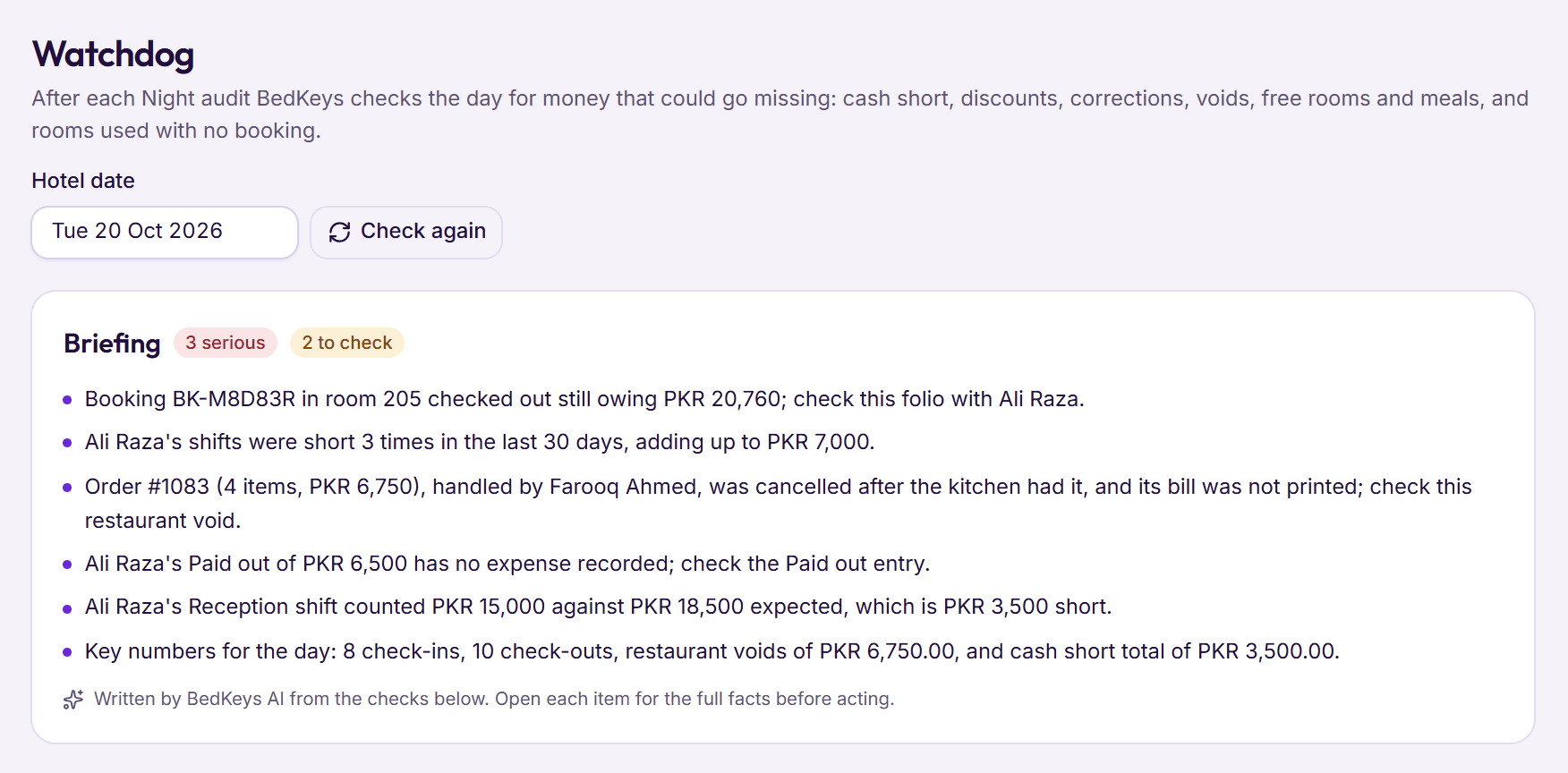
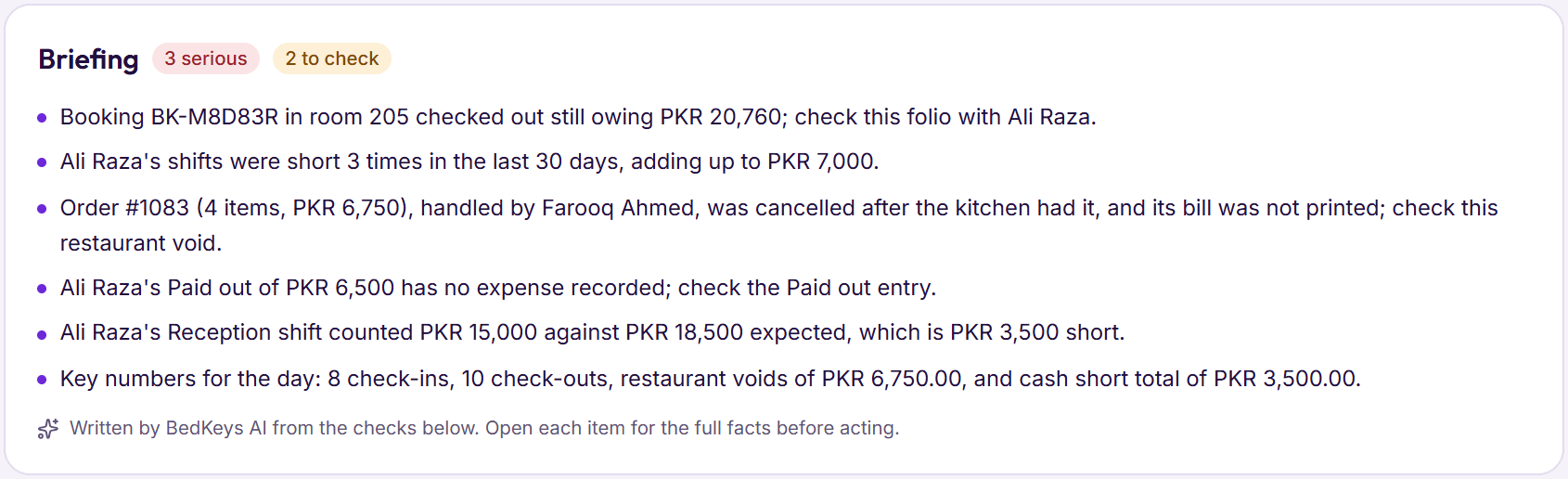
A few lines on what stood out: cash short, large discounts, voids, free rooms, guests who left owing. Read it top to bottom before you open anything.
Open what looks odd (3 minutes)
Pick the one or two items you don’t understand and open the record behind each: the folio, the restaurant bill or the cash shift. Don’t try to open everything.
Ask who owes you money (2 minutes)
Guests in the hotel with a balance, guests who left owing, and company accounts by how old the bill is.
Check the cash shifts (2 minutes)
Each shift’s expected and counted cash, who closed it, and any Paid outs. One short shift is usually a miscount. A pattern is not.
Ten minutes is a target, not a rule. On a quiet morning it takes five. On a morning with a serious item, the extra time goes on that one item, not on reading more.
Read the summary of last night’s close
Start with a summary, not with the raw reports. A day report with fifty lines makes every line look equally important. What you want first is a short list of what was unusual, with the most serious at the top: a shift that closed short, a discount far larger than usual, a dish voided after the kitchen cooked it, a room given free, a guest who checked out still owing.
Read it the same way every day. You are not looking for wrongdoing; you are looking for anything you can’t explain from what you already know. A free room for your cousin’s wedding guest is not news to you. A free room nobody told you about is.
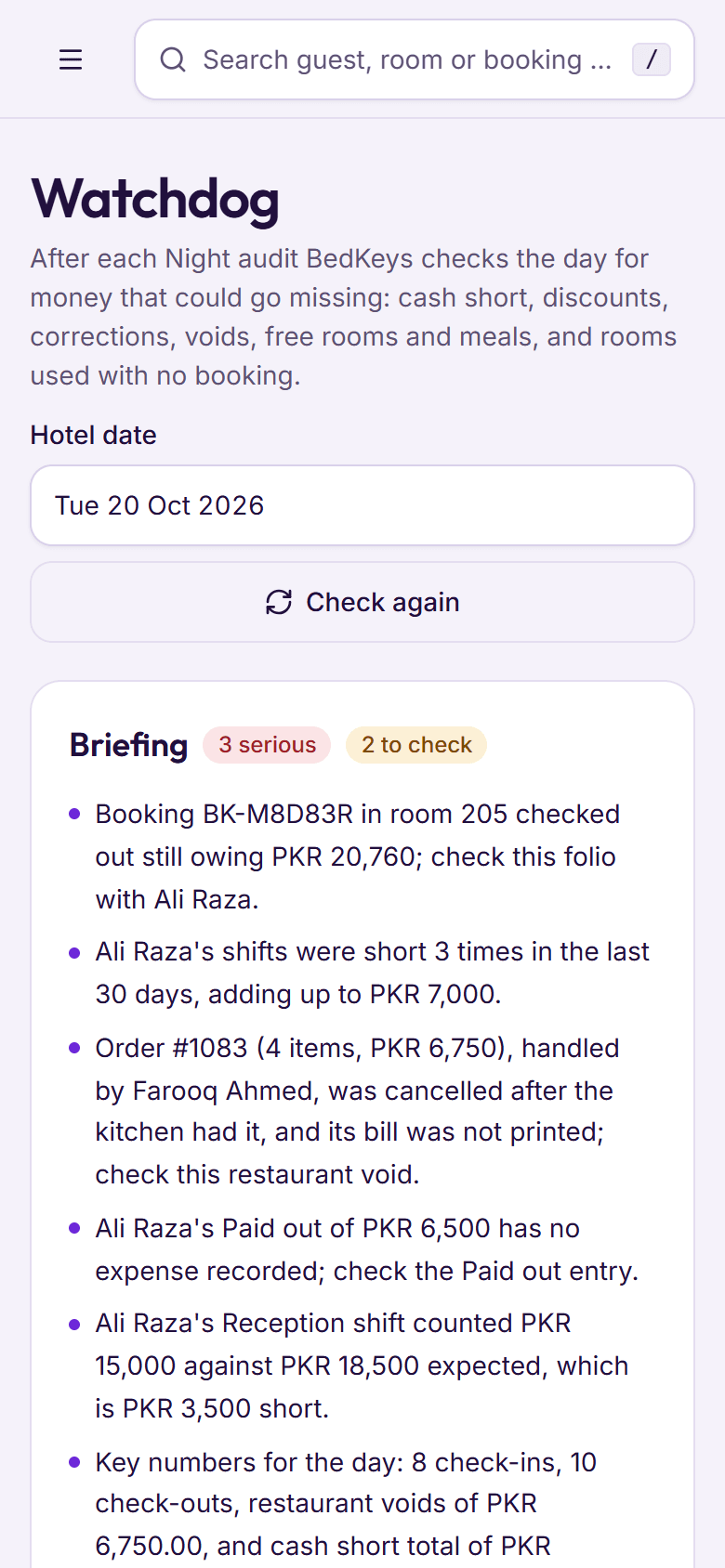
Open what looks odd, before you call anyone
The most useful habit a remote owner can build is to open the record before asking a question. A line that says “discount of $90 on room 112” could be a long-staying company guest on an agreed rate, or a mistake, or something worse. The folio usually tells you which: the reason given, who gave it, when, and what else is on the stay.
Once you have looked, most items fall into one of three groups. Each needs a different response.
| What the record shows | Usually means | What to do |
|---|---|---|
| A clear reason you agree with | A normal decision, recorded properly | Mark it as seen and move on |
| A reason, but one you didn’t expect | A decision you should have heard about | Ask the manager, and write down the answer |
| No reason, or one that doesn’t fit | A mistake, or a gap in the routine | Ask calmly the same day, while people remember |
| The same kind of item, again | A pattern, not a one-off | Look at the last 30 days before you talk to anyone |
When you do ask, ask about the record, not the person: “The folio for room 112 shows a $90 discount with no reason. What happened?” is a question. “Why did you give away $90?” is an accusation, and it teaches staff to write less, not more. Our guide to hotel revenue leakage has more on reviewing exceptions fairly.
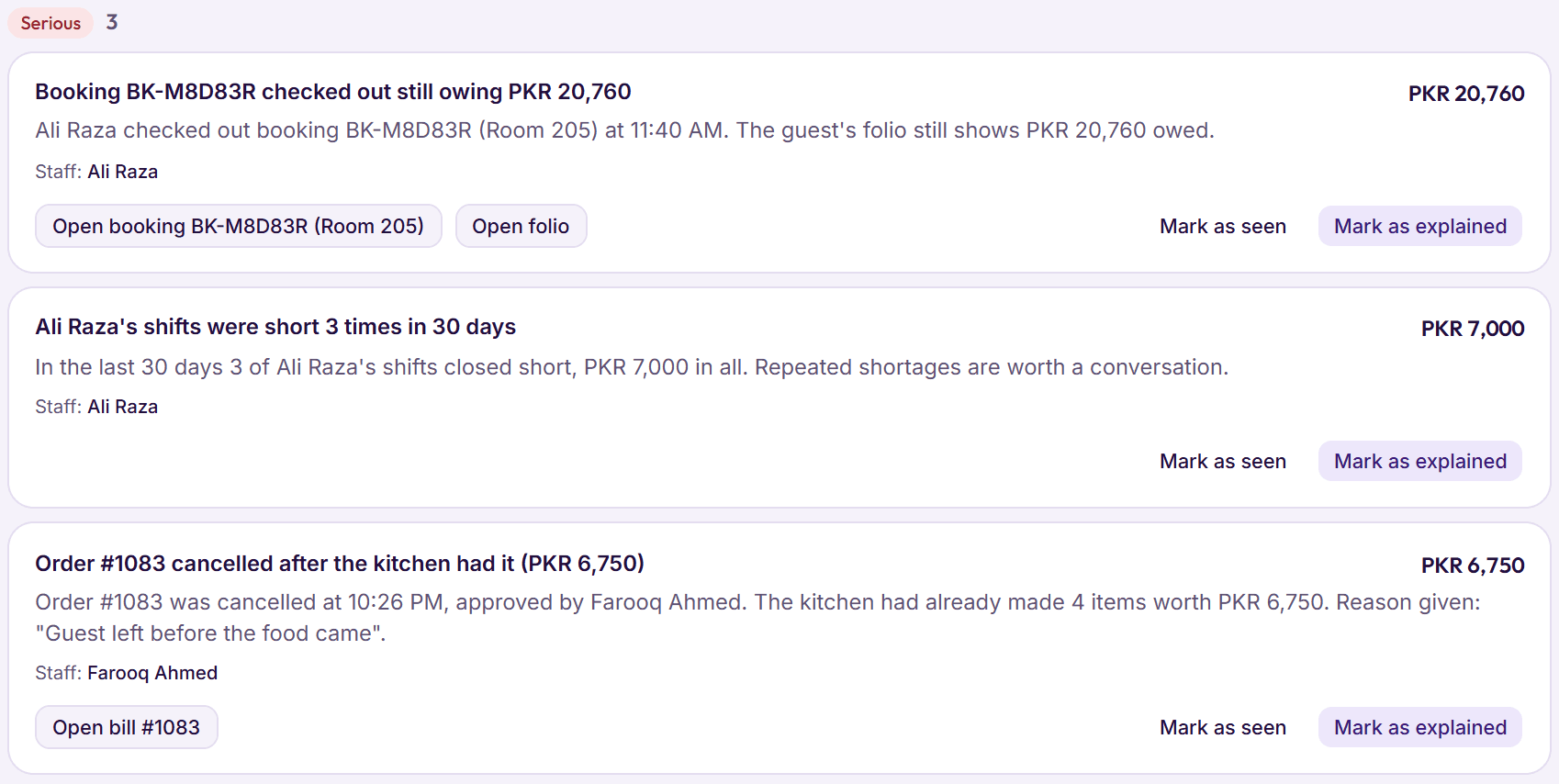
Ask “Who owes us money?”
Money that hasn’t been collected is the quietest leak in a hotel. Nobody stole it; it just never arrived. Three kinds of balance are worth a look every morning.
- Guests in the hotel with a large balance. A guest on the fourth night of a week-long stay with nothing paid is not a problem yet, but it becomes one at check-out. Ask the desk to take an advance payment or a part payment today.
- Guests who left still owing. A family checks out at noon with $60 of restaurant bills added after the folio was printed. Each one of these should be either collected, sent to a company’s account on purpose, or written off by someone who can decide that.
- Company accounts by age. A company that pays at the end of the month is fine. One with bills more than 60 days old needs a call, and one past 90 days needs a decision about whether it keeps its credit.
The figure you want is not just the total owed but the age of it. $2,000 owed this week by a regular company is ordinary. $400 owed for three months by a guest nobody can reach is the one to chase.
Check the cash shifts
Last, look at each cash shift from yesterday: how much cash it started with, what it should have held at the end, what was counted, and who closed it. Then look at what left the drawer during the shift: each Paid out, and each amount sent to the safe.
Example: the evening shift should end with $640 in the drawer. The count comes to $600, so the shift is $40 short. The shift also shows a $50 Paid out for a plumber, with a note but no expense recorded yet. Neither is proof of anything. Both are questions to ask today: was the drawer counted again, and where is the plumber’s receipt?
One short shift is almost always a miscount or a missed entry. Three short shifts in a month from the same drawer, or the same person, is a pattern worth a calm conversation. You only see that pattern if you read the shifts every day.
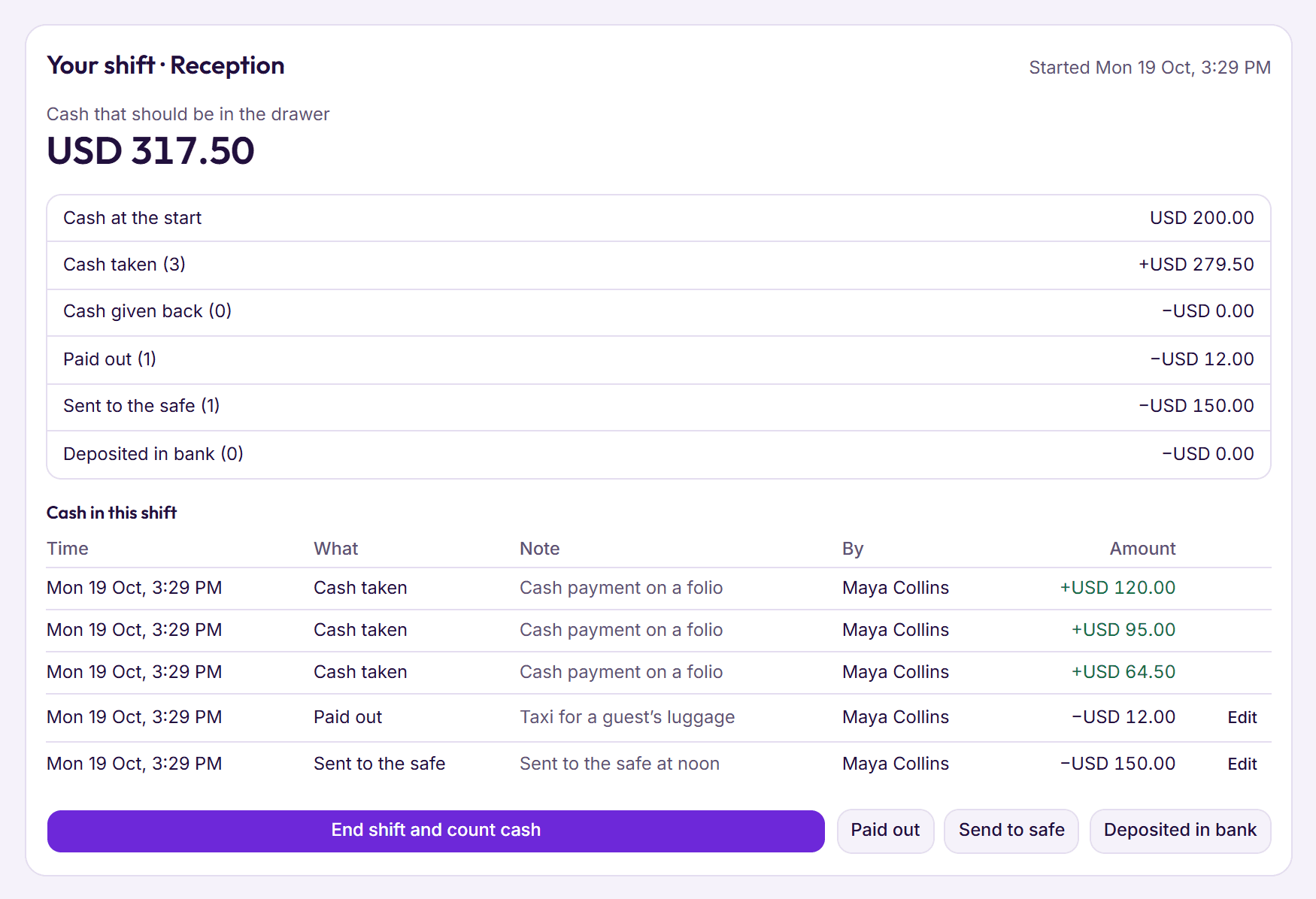
Write down what you found
When an item has a good explanation, record it next to the item: “Counted again with the night manager, the $40 was in the safe envelope.” It takes ten seconds, and it means that next month, when you look at 30 days together, you aren’t asking the same question twice. It also shows staff that a finding with a good reason is closed, not held against them.
Your ten minutes, every morning
- The hotel date has moved on: last night’s Night audit closed the day.
- You have read the summary of the close from top to bottom.
- You opened the record behind anything you couldn’t explain.
- You know who owes money: in-house guests, guests who left owing, and company accounts by age.
- Every cash shift was counted, and any short or over has a reason.
- Every Paid out has a note, and an expense is on its way.
- Each item you looked into is marked, with a note where there was an explanation.
Once a week: look at 30 days
Single days are noisy. Once a week, give it another fifteen minutes and look at the last 30 days together, by staff member. You are looking for two things: one person far above the rest of the team at the same job (discounts, corrections, voids, short shifts), and a total that keeps growing week on week.
This is also the time to read the figures that tell you how the hotel is doing, not just whether the money is safe: occupancy, average rate and revenue per available room against the weeks before. Our guide to occupancy, ADR and RevPAR explains each one in plain words.
When something doesn’t add up
Sooner or later the routine finds something that needs more than a note. When it does, a few rules keep it fair and keep your staff on your side.
- Call the same day. A question asked this morning gets a real answer. The same question asked in three weeks gets a guess.
- Start with the manager, not the staff member. Unless the manager is the one in the record, let them ask first; they know the context you don’t.
- Bring the record. Read out what it shows: the amount, the time, the reason given. Let the person explain before you draw a conclusion.
- Fix the routine, not just the day. If a Paid out had no receipt, the answer is a rule that every Paid out gets an expense the same day, not a one-off telling-off.
- Treat everyone the same. Managers give discounts and free rooms too. Checks that cover every role are fair, and staff can see that they are.