What a cash handover is, and why drawers come up short
A cash handover is the moment one front desk shift passes the cash drawer to the next. The outgoing person counts what is there, the incoming person agrees the count, and both know exactly what the new shift starts with.
When a drawer comes up short, the cause is often not one large amount but a gap in that routine: cash taken out with no note, a cash payment entered as card, a count done the next morning, or two people working the same drawer. Each gap makes it impossible to say where the money went, and leaves an honest person unable to show it wasn’t them.
Start the shift with a float
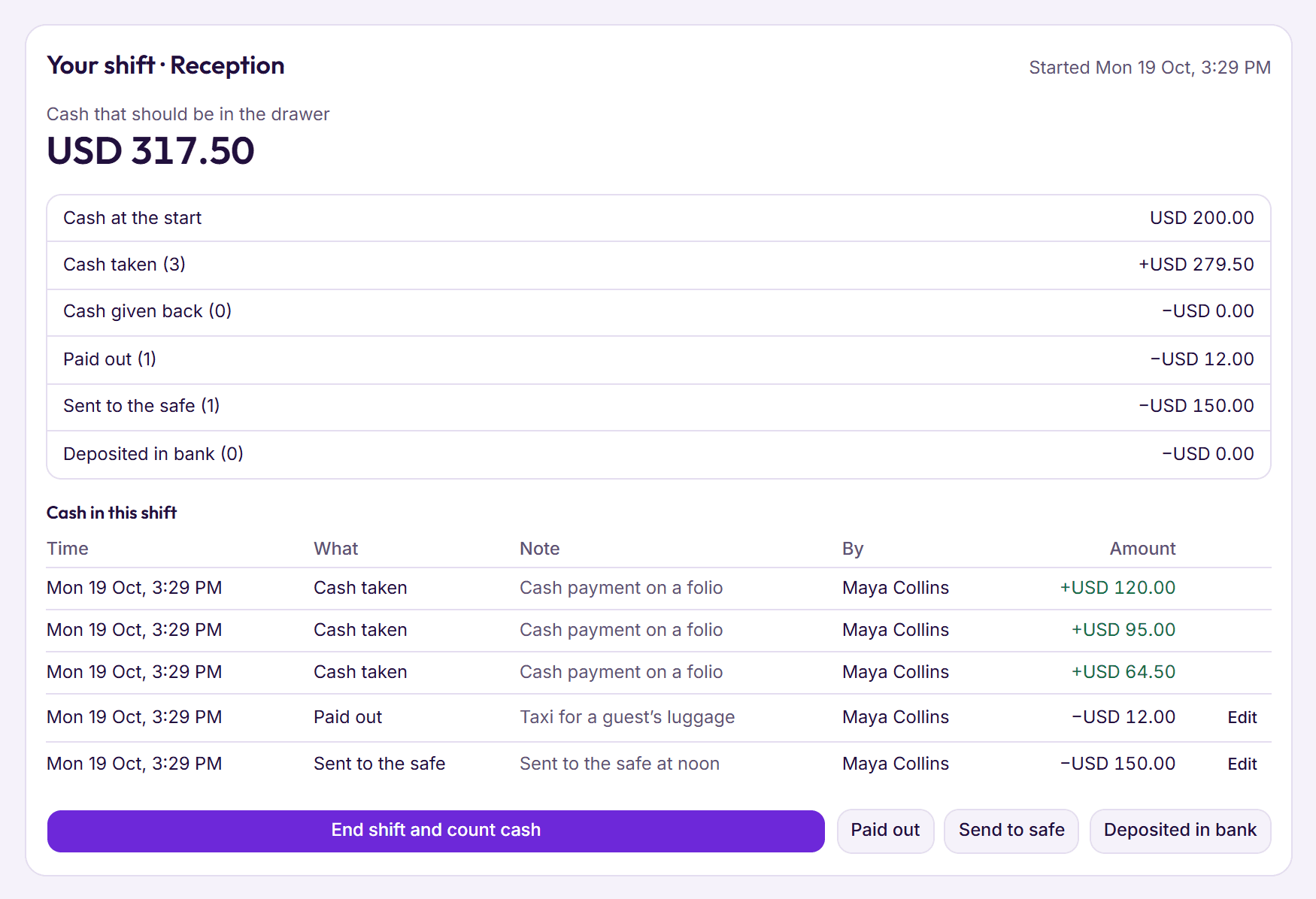
The float is the cash in the drawer at the start of a shift, kept for giving change. Keep it the same amount every shift, so a count that doesn’t match is noticed at once.
The person starting the shift counts the float themselves before taking any cash. If it doesn’t match, they say so before the outgoing person leaves, not an hour later.
Paid outs: a note every time
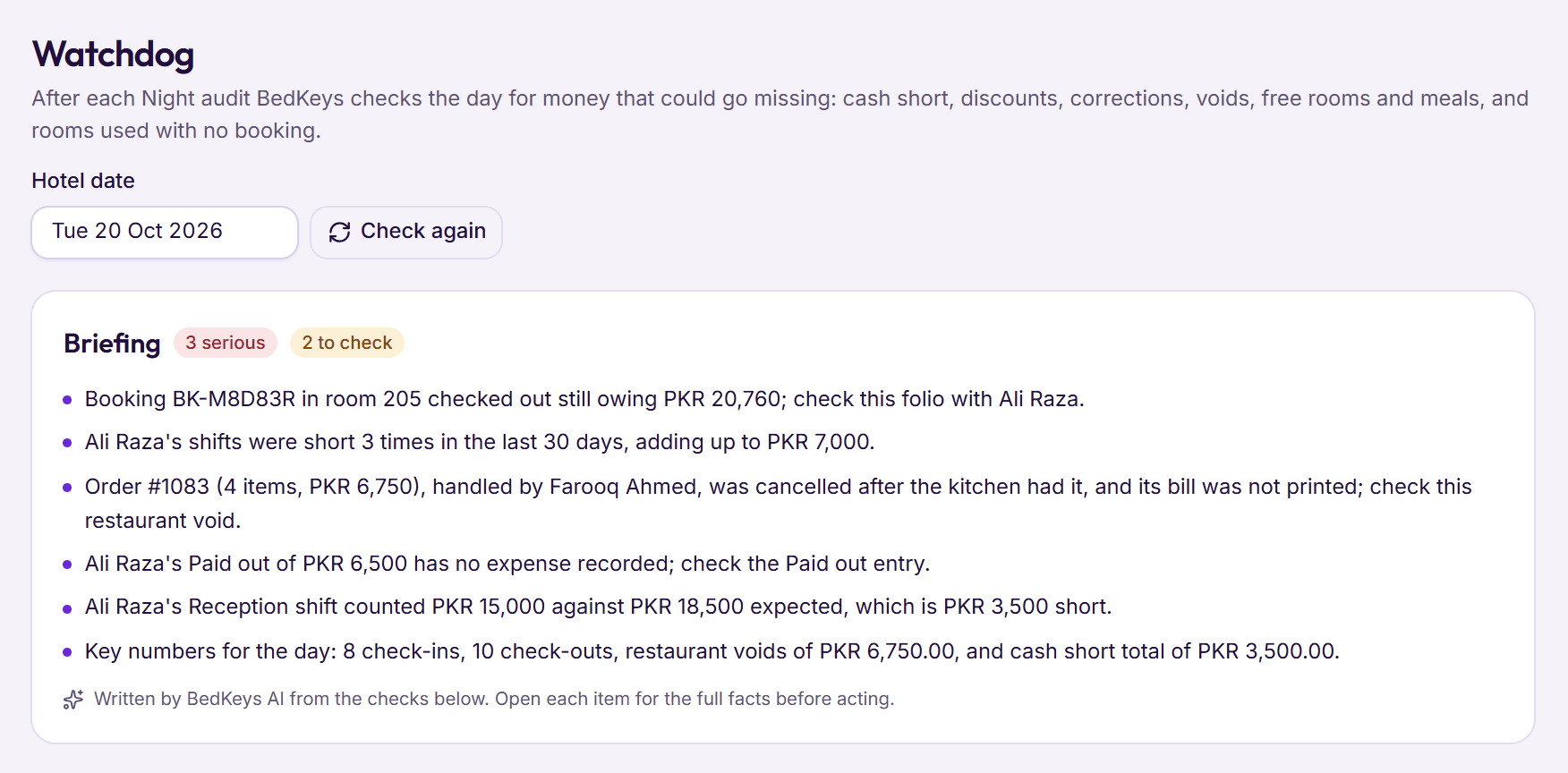
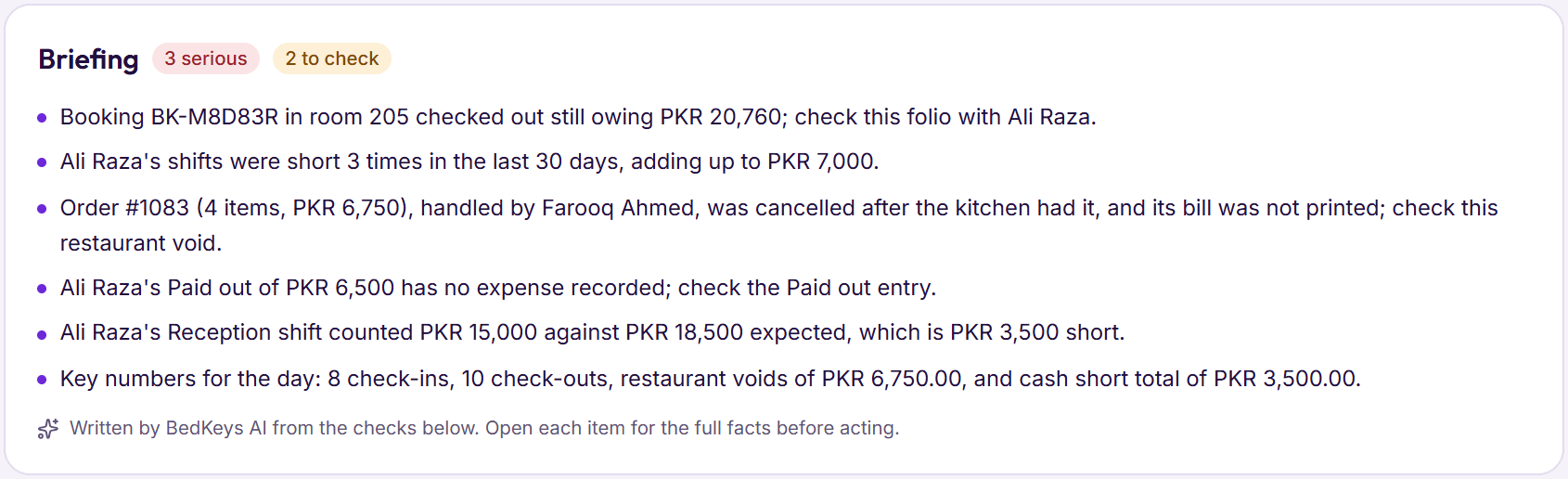
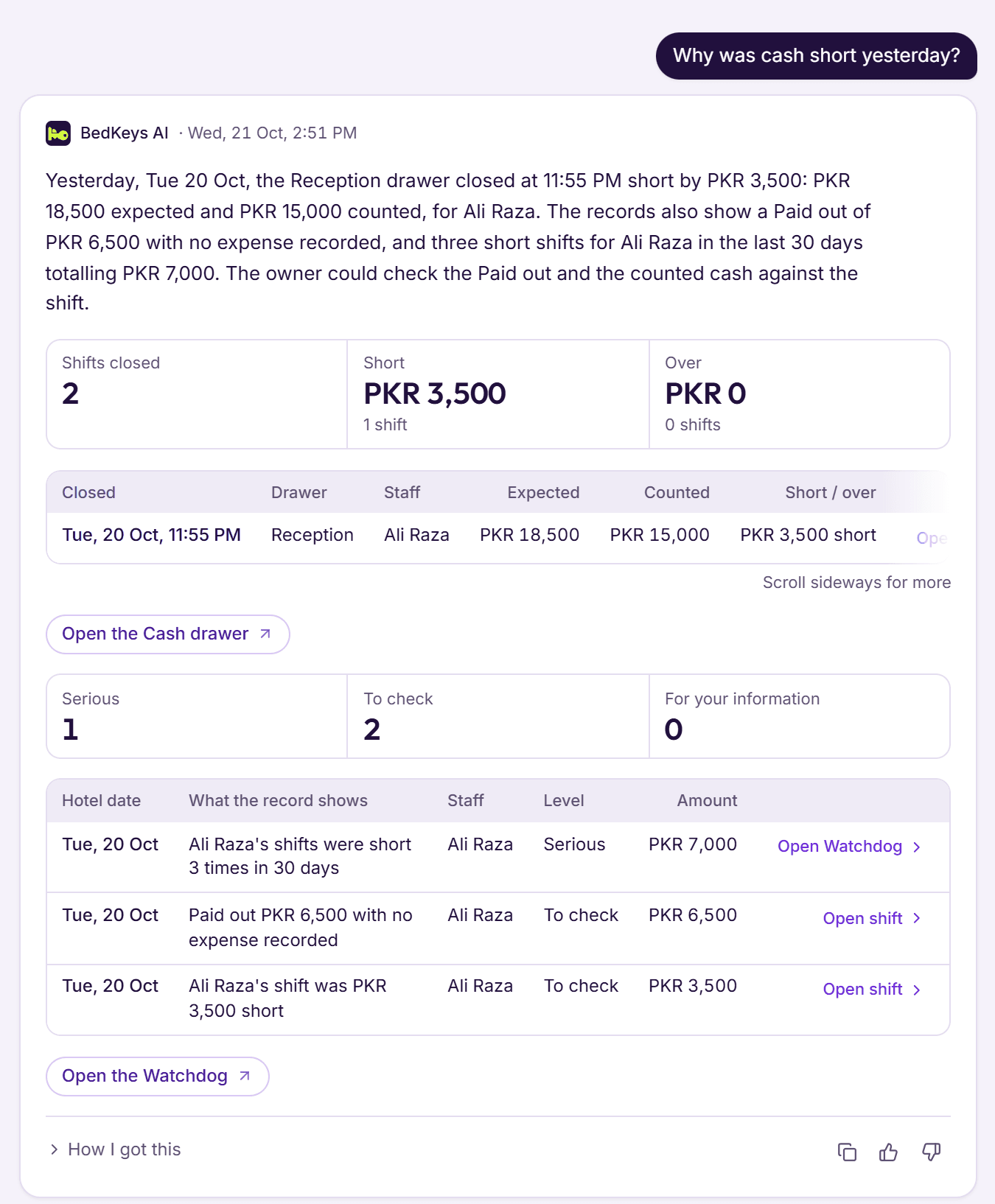
Cash leaves the drawer during a shift for real reasons: diesel for the generator, a plumber, a taxi for a guest. A petty-cash payout (in BedKeys, a Paid out) is normal. A Paid out with no note is how a drawer goes short with nobody able to say why.
- Record the Paid out when the cash leaves, not at the end of the shift.
- Say what it was for and who took it: “Diesel, 20 litres, Imran.”
- Keep the receipt with the drawer, and enter it as an expense the same day.
- Above an amount you set, ask a manager before the cash leaves.
Example: PKR 6,500 leaves the drawer for diesel. With a note and a receipt, it is a cost the books can show. Without them, it is a shortfall the next count can’t explain.
Sending cash to the safe
A drawer holding a whole day’s takings is a risk for the person working it. Once the cash passes an amount you choose, send the extra to the safe during the shift and leave the float in the drawer.
Record each drop as it happens: the amount, the time and who took it to the safe. Cash sent to the safe still belongs to the shift. It is part of what the shift took; it just isn’t in the drawer at the count.
Count at the end of the shift
At the end of each shift, the person who worked the drawer counts it before handing over. Not the next person, and not the next morning: by then two shifts have touched the cash, and nobody can say whose difference it is.
The drawer should hold the float, plus the cash taken, less the cash paid out, given back to guests or sent to the safe.
| Line | PKR |
|---|---|
| Float at the start | 10,000 |
| Cash taken: folios, advance payments and restaurant bills | + 48,500 |
| Paid outs | − 2,500 |
| Sent to the safe | − 40,000 |
| Should be in the drawer | 16,000 |
| Counted | 15,500 |
| Short | 500 |
Count the notes by value, write down each total, then add them up. If the result doesn’t match, count again, with the next person watching, so the handover starts from a figure both agree on.
Short or over: signed off, not argued over
A drawer is short when it holds less than it should, and over when it holds more. Both matter. An over drawer often means a charge that wasn’t entered or change that wasn’t given, and it can hide a short one just as well.
Record the difference
The amount, the shift and the person who counted, written down before anyone goes home.
Write the reason, if there is one
“Gave PKR 500 too much change to room 108; the guest will bring it back.” A reason written tonight saves an argument next week.
A manager signs it off the same day
Signing off means the manager knows and has read the reason, not that anyone is blamed.
Look at 30 days, not one
One short shift is usually a mistake. Three in a month from the same drawer is worth a calm conversation.
One drawer per person per shift
The simplest rule is the one most often broken: one drawer, one person, one shift. If two people take cash from the same drawer, a shortfall belongs to both of them and to neither. Nobody can show it wasn’t them, and the honest one carries the doubt.
- If two people work the desk, give each their own drawer, or let only one of them handle cash.
- The restaurant keeps its own drawer, apart from reception.
- Nobody takes cash from a drawer that isn’t theirs, even “just for change”. Change comes from the safe, with a note.
- A shift that ends is closed and counted, even if the same person starts the next one.
A printable cash handover checklist
Print this and keep it by the drawer. It works with any software, or with none.
Start of the shift
- The drawer is yours alone for this shift.
- You counted the float yourself, and it matches the amount it should be.
- Any difference was raised before the last shift left.
During the shift
- Every cash payment is entered as cash, at the moment it is taken.
- Every Paid out is recorded when the cash leaves, with what it was for, who took it and the receipt.
- Cash above your limit has gone to the safe, with the amount, the time and who took it.
- Nobody else has taken cash from your drawer.
End of the shift and handover
- You counted the drawer yourself, note by note, before handing over.
- Short, over or matching is recorded, with a reason for any difference.
- The next person has counted what they take over and agrees the figure.
- Paid out receipts are with the manager or entered as expenses.
- A manager has signed off any short or over the same day.