What is a Night audit?
A Night audit is the end-of-day close at a hotel. Once the last expected guest has arrived or been accounted for, someone at the front desk checks the day’s bookings, payments and cash, posts the night’s room charges to every guest still in the hotel, and moves the hotel onto the next business day.
The name comes from the night shift, which usually does it, but the job is about money, not the hour. A hotel’s business day doesn’t end at midnight: a guest who arrives at 1 a.m. still belongs to the night before. That’s why hotels keep a hotel date that only moves on when the Night audit says so.
Why the day shouldn’t close with loose ends
Every report an owner reads (occupancy, average rate, revenue by department, cash by shift) is built from closed days. If a day closes while a guest who never came is still marked as arriving, tonight’s occupancy is wrong. If a cash shift is still open, nobody has counted the drawer. If a guest who left this morning is still in the hotel on paper, their room gets charged a night they never stayed.
Each of these is small. Together they are why so many hotels can’t say what they really made last month. The fix is a rule, not a better spreadsheet: the day doesn’t close until nothing is left loose.
What the Night audit does, step by step
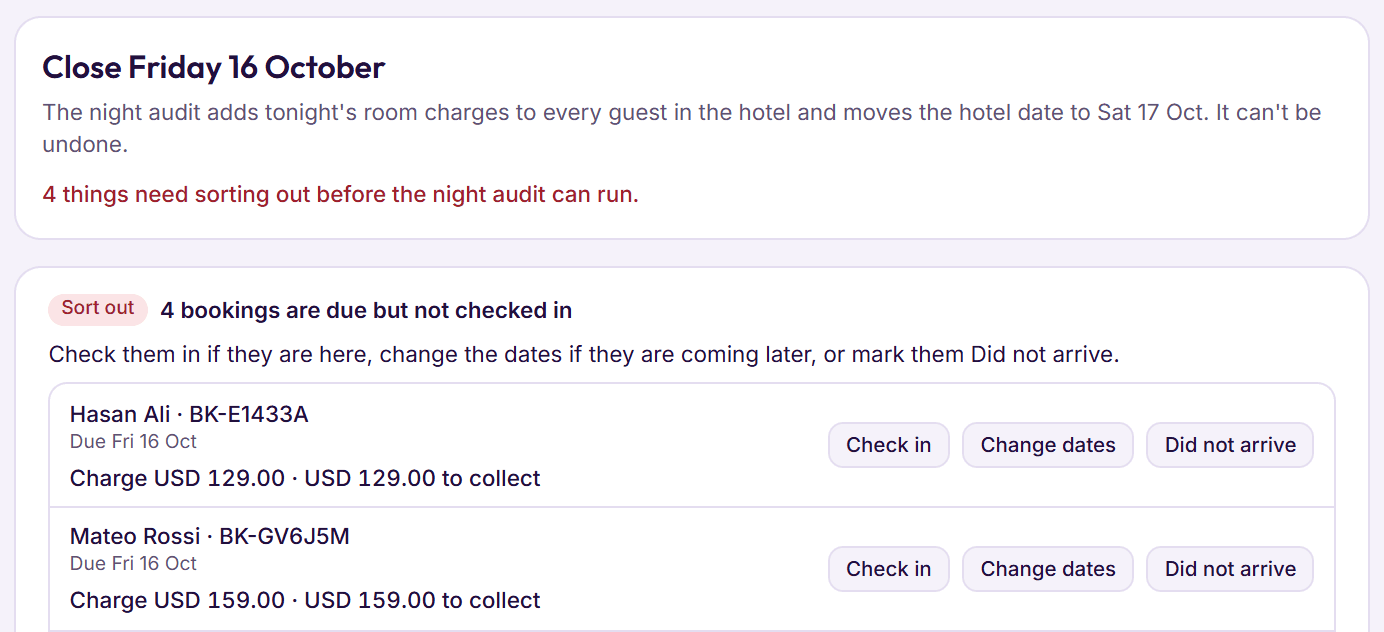
Sort today’s arrivals
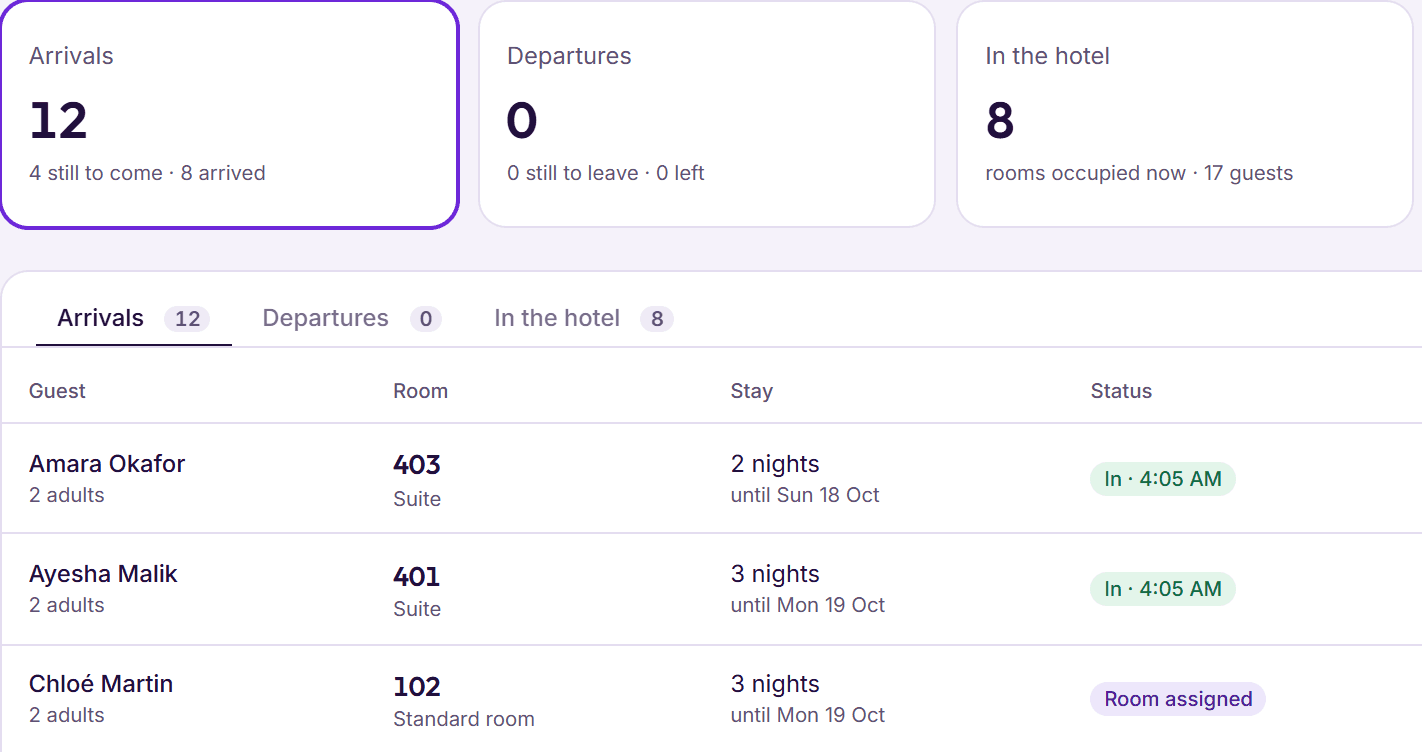
Every booking due today is either checked in, moved to new dates, or marked as a guest who did not arrive (often called a no-show). A late arrival you’re still expecting gets its dates changed, not left hanging.
Sort today’s departures
Every guest due to leave has checked out, or the stay has been extended on purpose. A guest who left without checking out is found now, not at the end of the month.
Close the open cash shifts
Each drawer is counted. The system says whether it is short, over or matches what it should hold, and the person who counted it is on the record.
Post the room nights
Each guest still in the hotel gets tonight’s room charge on their folio, at the price agreed when they booked, with its tax.
Move the hotel date
The business day closes. Tomorrow’s arrivals, departures and reports start from a clean, finished day.
A Night audit checklist for your night staff
Print this and keep it at the desk. It works whatever software you use, and it is the order BedKeys follows.
Every night, before the day closes
- All of today’s arrivals are checked in, moved to new dates, or marked Did not arrive.
- All of today’s departures are checked out, or their stay has been extended on purpose.
- Guests leaving who still owe money have been settled or sent to their company’s account.
- Every open cash shift has been counted and closed, with any short or over amount explained.
- Restaurant bills charged to rooms are on the right guests’ folios.
- Rooms out of order have a reason, and none of them has a guest due in tonight.
- The room nights have been posted to every guest still in the hotel.
- The hotel date has moved on, and the day report is ready for the morning.
Common Night audit mistakes
- Closing the day to get home. If the system lets the night staff skip a step, someone eventually will. The checks have to stop the close, not just warn.
- Leaving “no-shows” as arrivals. A guest who didn’t come should be marked Did not arrive, so any fee in your cancellation rules can be charged, and the room counts as free.
- Counting the drawer in the morning. By then two shifts have touched it, and nobody can say whose shortfall it is. Count at the end of each shift.
- Changing room prices at the audit. The night’s charge should be the price agreed at booking. Changes belong to the booking, with a reason.
- Nobody reads the result. An audit nobody looks at is just paperwork. The owner or manager should read the day’s close every morning, even from home.
Who should do the Night audit, and when?
Pick one time and keep it: most hotels close between midnight and 2 a.m., after the last expected arrival. Give the job to a named person on each night shift, not to “whoever is at the desk”. In a smaller hotel this is often the night receptionist; in a larger one, a night manager. Either way, the owner or general manager reads the result first thing the next morning.