What a booking-site booking really costs
When a guest books your room on a booking site, the site takes a commission: a share of what the guest pays for the room. The rate depends on your contract, your country and whether you pay for extra visibility in the site’s search results. Rates commonly run around 15–25%. Your own contract has the real figure, and it is worth finding before you read on.
The commission is easy to miss, because it rarely leaves your hand as one large bill. Depending on the contract, the site either collects the guest’s payment and passes on what is left, or sends you an invoice for the month’s commission later. Either way, the room price on the booking is not the money the hotel keeps.
Online travel agencies (OTAs) is the industry’s name for booking sites. Whatever you call them, the owner’s question is the same: what does each booking cost, and is it worth it? Check two things in your contract first: the commission rate, and whether it is charged on the price before or after tax.
A worked example: the same stay, booked two ways
Take one stay and book it two ways. The figures below are examples, not anyone’s real rates: a room at PKR 20,000 a night, a 3-night stay, and an assumed commission of 18%. Tax is left out to keep the sums plain, because it goes to the government whichever way the guest books.
| Through a booking site | On your own booking page | |
|---|---|---|
| Room price for 3 nights | PKR 60,000 | PKR 60,000 |
| Commission | PKR 10,800 (18%) | PKR 0 |
| What the hotel keeps | PKR 49,200 | PKR 60,000 |
| What the hotel keeps per night | PKR 16,400 | PKR 20,000 |
On this one stay, the booking site’s share is PKR 10,800: more than half of one night’s price. Nothing else about the stay changes. The room is cleaned the same way, the guest is checked in at the same desk, and your team does the same work for less money.
The rate makes a large difference, so it helps to see a range. Here is the commission on the same PKR 60,000 stay at four example rates.
| Commission rate | Commission on the stay | What the hotel keeps |
|---|---|---|
| 15% | PKR 9,000 | PKR 51,000 |
| 18% | PKR 10,800 | PKR 49,200 |
| 20% | PKR 12,000 | PKR 48,000 |
| 25% | PKR 15,000 | PKR 45,000 |
One stay is easy to shrug off. A month is not. If ten stays like this one came to you direct instead of through a booking site at 18%, the hotel would keep PKR 108,000 more that month, on the same rooms and the same guests.
A direct booking isn’t free either
A booking on your own page carries no commission, but it still costs something. Be honest about these costs, or the comparison flatters direct bookings.
- The booking page itself. A booking engine (the software behind your booking page) usually has a monthly fee, a fee for each booking, or both. Check which. A fee for each booking is a commission by another name.
- Your team’s time. Someone has to answer guests on WhatsApp, check that bank transfers have arrived, and keep prices and photos up to date.
- Getting found. A booking site spends its own money putting your hotel in front of travellers. Your own page only gets the visitors you send it.
- Guests who don’t come. A direct guest who doesn’t turn up (a no-show; in BedKeys, Did not arrive) costs you the room if nothing was paid. Ask for a deposit (in BedKeys, an advance payment) on the dates when an empty room hurts most.
Even with these costs, the sums often favour direct for guests who already know you. A guest who has stayed before doesn’t need a booking site to find you. Paying a share of their stay for an introduction they no longer need is the cost worth cutting.
Why you still need booking sites
It would be easy to read the tables above and decide to leave the booking sites. For most hotels that would be a mistake. Booking sites reach travellers you can’t: people from other cities and other countries, planning a trip and comparing hotels they have never heard of. Many of them would never find your page on their own.
For those guests, the commission pays for something real. It is the cost of a new guest, much like an advertisement you only pay for when it works. A room sold through a booking site earns less than the same room sold direct, but it earns far more than a room left empty.
So the aim is not to stop taking booking-site bookings. It is to stop paying commission on guests who would have booked with you anyway.
Which guests to win back: repeat and local guests
Three groups of guests are the best place to start, because they already know you, or can reach you without help.
- Returning guests. Someone who stayed last year and books again through a booking site is paying the site to find a hotel they already know. Often it is habit, or the first link they saw.
- Local and nearby guests. Families from the same city, companies booking rooms for their visitors, and guests a few hours’ drive away can reach you by phone or WhatsApp. They can just as easily book on your page.
- Guests who look you up. Some travellers see your hotel on a booking site, then search your name to learn more. If your own page is easy to find when they do, some of them will book there.
Leave first-time guests from far away to the booking sites. Then win them back for their second stay.
How to move guests to your own booking page
Moving guests direct is mostly a matter of habit, yours and theirs. Give them an easy way to book, in the places they already talk to you.
Have a page that is as easy as a booking site
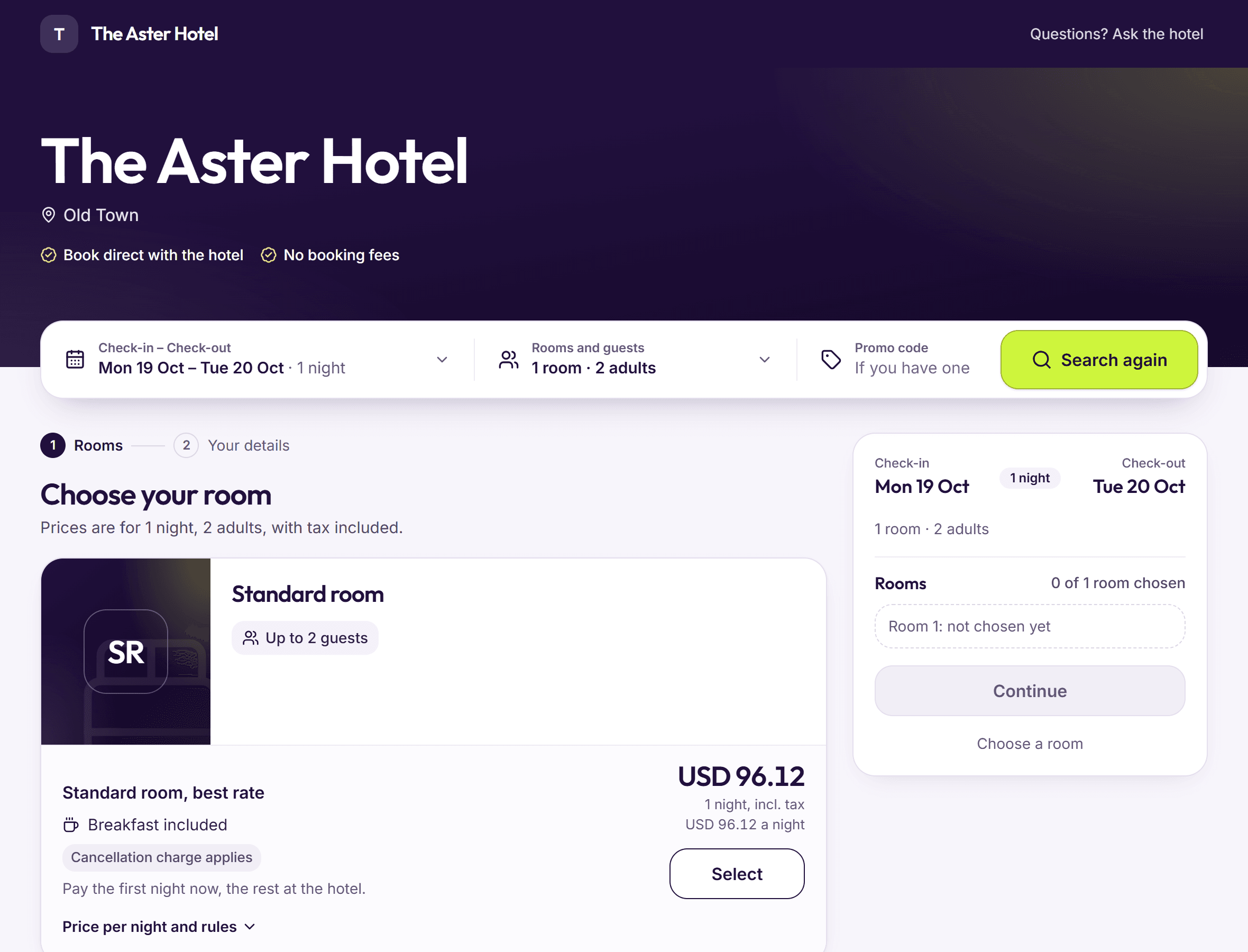
Guests are used to seeing photos, prices and free rooms in a few taps. Your page needs the same: room photos, a price with tax already included, and booking in a few steps on a phone. If booking direct is harder, they go back to the booking site.
Put the link where guests already look
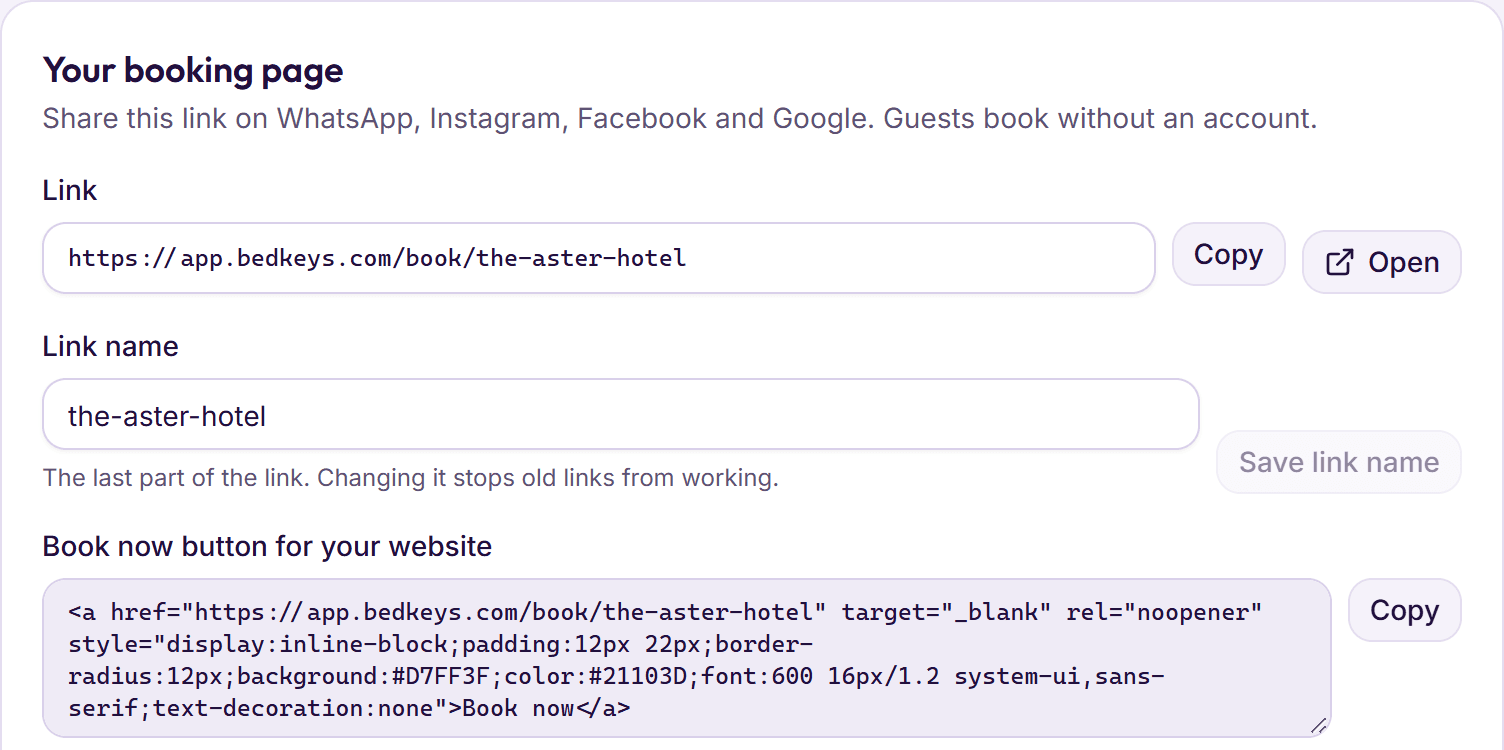
Add your booking link to your Instagram profile, your Google listing and your WhatsApp Business profile. If you have a website, put a Book now button on it, so visitors don’t leave to book somewhere else.
Reply on WhatsApp with a ready-made link
When a guest asks about dates on WhatsApp, reply with a link that already has their dates and number of guests filled in. They see the right rooms at once and book without typing it all again.
Give returning guests a promo code
At check-out, or in your thank-you message, give the guest a code for their next stay. A modest discount usually costs much less than a booking-site commission, and it gives them a reason to come to you first.
Keep every guest’s own details
Whichever way a guest booked, make sure their own mobile number is on their profile before they leave. Next season, that is how you reach them.
Moving repeat and local guests to booking direct
- Your booking page shows room photos and prices with tax included, and is easy to use on a phone.
- The link is on your Instagram profile, your Google listing and your WhatsApp Business profile.
- Your website, if you have one, has a Book now button.
- Staff reply to questions on WhatsApp with a link that has the guest’s dates filled in.
- Returning guests get a promo code for their next stay, at check-out or in the thank-you message.
- Every guest’s own mobile number is on their profile, whichever way they booked.
- Your booking-site contract allows the prices and codes you plan to offer.
- Each month, someone checks how many bookings came direct and how many came through booking sites.
How to tell if it’s working
Measure two numbers each month: the room nights booked direct, and the commission you paid. Count bookings by where they came from in your records, not by what the desk remembers. If direct room nights go up while returning guests stop arriving through booking sites, it is working.
Don’t judge it after a week. Guests change habits slowly, and a returning guest with a promo code may not come back for months. Compare with the same month last year as well as last month, because the seasons move both numbers.
To set that against the example above: for a hotel with 20 rooms, BedKeys Direct costs PKR 4,000 a month more than BedKeys Core (PKR 200 a room). The commission on the one 3-night stay in the example was PKR 10,800. The full figures are on BedKeys Direct pricing.